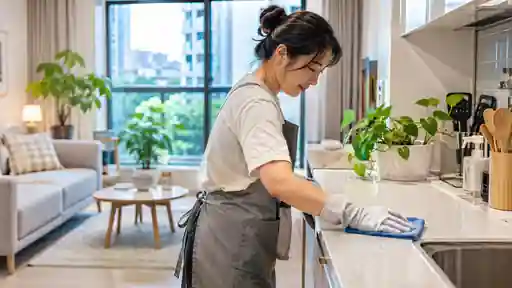
Looking for someone to clean your home once a week in Korea? You can try a housekeeping app, an English-assisted service where available, or a cleaner recommended locally. Which works best depends on your address, schedule, budget and the kind of help you need.
Before choosing, check what the cleaner will actually do during each visit, whether you can book the same person regularly, and how the total cost compares.
How much does a weekly cleaner cost in Korea?
For a useful public benchmark, Miso (미소) publishes average prices for recurring home-cleaning visits:
| Visit length | Published recurring price | Four weekly visits |
|---|---|---|
| 2 hours | ₩38,900 | ₩155,600 |
| 3 hours | ₩52,900 | ₩211,600 |
| 4 hours | ₩66,900 | ₩267,600 |
These are Miso’s advertised averages, not nationwide rates or guaranteed quotes for your address. Availability and prices can vary by city, neighbourhood and cleaning date. Four visits are shown for easy comparison; a calendar month may contain five weekly appointments.
One-off visits are more expensive on Miso’s current published table: ₩42,900 for two hours, ₩59,900 for three and ₩75,900 for four. If you want regular help, ask about the recurring rate instead of assuming the one-time rate applies indefinitely.
For an example of English-assisted booking in Seoul, Balli Balli Seoul advertises housekeeping from ₩70,000 for a three-hour visit. This is a Seoul-specific option, not a nationwide service or price benchmark. Ask for the total including any coordination fee.
Three ways to book a house cleaner
1. Miso (미소): recurring housekeeping through an app
Miso’s home-cleaning page lets customers select a time and schedule and describes regular visits with a designated cleaner. It lists kitchen, bathroom, living-room and other household tasks, along with work it does not provide. Check the exact service scope before assuming anything beyond standard housekeeping.
In an April 2022 discussion in our Facebook Group, a member shared a positive experience with Miso’s air-conditioner cleaning service. Useful as a firsthand experience, but it doesn’t tell us how Miso’s weekly housekeeping performs today.
2. Cleaning Lab (청소연구소 / 청연): another app-based option
Cleaning Lab’s app listing describes one-time and recurring housekeeping, as well as separate apartment and appliance-cleaning options. It is worth comparing availability, service terms and the actual quote for your address with Miso.
The app and customer support may operate primarily in Korean. Check the language and payment requirements before committing, especially if you are new to Korean service apps.
3. English-assisted booking or a local cleaner
In Seoul, Balli Balli Seoul offers English-language coordination for regular housekeeping in its listed service areas. Elsewhere in Korea, ask local cleaning companies or independent providers whether they can handle booking in English or through translated messages. For any coordination service, confirm its fees, who actually performs the cleaning and who handles complaints.
If you find an independent cleaner through a neighbour, building manager, or a recommendation in our group, that can work too. But clarify the hourly rate, minimum visit length, references, cancellation arrangements and whether you can request the same person each time.
Weekly housekeeping is not the same as a deep clean
This distinction matters more than people expect.
Regular housekeeping (가사도우미 / 정기청소) is for ongoing maintenance: floors, dusting, bathrooms, counters and possibly dishes, laundry or general tidying within the booked time.
Move-in or deep cleaning (입주청소 / 대청소) is a more intensive visit. It may involve an empty apartment, cabinet interiors, hard-to-reach areas and accumulated grime. It is usually quoted differently.
Appliance cleaning (에어컨청소 / 세탁기청소) can involve disassembling an air conditioner or washing machine. Don’t book ordinary housekeeping and expect a technician to do this.
Decluttering and organizing (정리수납) is a separate kind of help. Someone may need assistance sorting belongings and restoring order before a routine cleaner can maintain the space.
These needs show up in different situations. In a January 2025 discussion in our Facebook Group, someone needed a deeper clean to tackle pet hair left behind by a previous tenant. In another discussion, someone was looking for nonjudgmental cleaning and organizing help, with the possibility of regular visits afterward. Neither job is necessarily a good match for a basic two-hour housekeeping appointment.
A helpful way to explain your situation is to say whether the home needs a one-time reset, regular maintenance, or both. You do not need to apologize for needing help. If the first job is more than routine cleaning, our guide to finding deep cleaners and organizers in central Seoul covers that kind of service in more detail.
How long should you book?
For a smaller apartment that is already reasonably tidy, two hours may be enough for a few priority tasks. Three or four hours may suit a larger apartment or a visit that includes kitchens, bathrooms and laundry.
But no hourly estimate works for every home. The number of bathrooms, pets, stairs, clutter and the condition of the apartment all affect what can be done. If this is your first appointment, consider booking enough time to assess the real workload and then adjust your regular schedule.
Questions worth asking before your first visit
- Scope: Are dishes, bathrooms, laundry, inside cabinets or changing bedsheets included? What is expressly excluded?
- Supplies: Do you provide cleaning sprays, gloves and a vacuum, or does the cleaner bring them?
- Continuity: Can you request the same cleaner weekly? What happens if they cancel?
- Access: Must you be home? If sharing a door code, how is it handled and when should it be changed?
- Fees: Is the total inclusive of booking fees, service charges and any materials?
- Problems: Who handles property damage, poor results, a missed visit or a refund request?
For a private hire, avoid sending a door code or paying a large advance before you have confirmed the person’s identity and arrangements. Platform booking can simplify payment or complaints, but it is still worth understanding the actual terms.
Korean message to request weekly cleaning
Here is a natural message you can copy into KakaoTalk or a booking enquiry:
안녕하세요. [시/구/동]에서 일주일에 한 번 정기적으로 집 청소를 도와주실 분을 찾고 있습니다. 집 크기는 [평수/㎡]이고, 주로 화장실, 주방, 바닥 청소를 부탁드리고 싶습니다. 1회 방문 가능 시간과 비용, 청소도구 준비 여부, 같은 담당자분의 정기 방문 가능 여부를 알려주실 수 있을까요? 감사합니다.
Replace [시/구/동] with your city and neighbourhood, such as 부산 해운대구 or 서울 강남구. The message asks about price, visit length, supplies and whether the same cleaner can return regularly. Change the home size and tasks to suit your needs.
Useful Korean searches include [지역명] 가사도우미 (housekeeper in your area), [지역명] 정기청소 (recurring cleaning locally), 집청소 업체 (house-cleaning company) and 정리수납 서비스 (organizing service). Replace [지역명] with your city or neighbourhood.
Where to start, wherever you live in Korea
For straightforward weekly cleaning, first check whether Miso or Cleaning Lab serves your actual address and compare the available appointments. If neither operates in your area, search locally using your city name or ask neighbours for a cleaner they have used. If Korean-language booking is an obstacle, ask whether the provider supports English or written messages and clarify any coordination fees.
A quick trial appointment may tell you more than a long list of anonymous recommendations. After the first visit, you will know whether the cleaner’s work suits your home and how much time to book regularly.
Please do your own research and verify current rates, scope, staffing arrangements and terms directly with each provider before booking. The linked community posts are individual experiences from different times, not guarantees or endorsements. Every Expat in Korea has not independently audited the providers or verified their coverage at your address.